Category Archives: computer

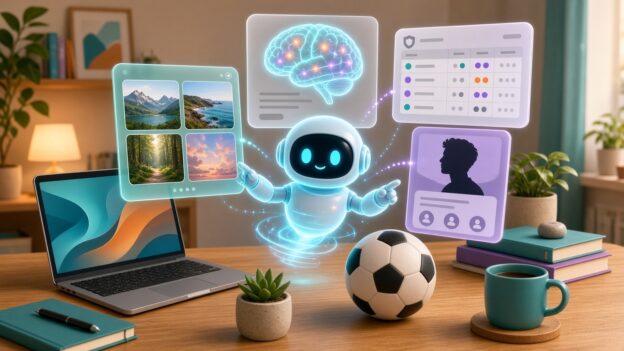
A friendly glowing robot assistant arranging floating web page cards above a laptop, with a brain scan motif and a soccer ball on the desk

My Website Was a Fossil. Grok Bot Made It Fun Again.

Originally published on snarky.tech.

Confession: my personal website, adamnoah.com, had become a fossil. The kind of site you keep paying hosting for out of guilt, where every update is filed under “I’ll get to that this weekend.”

I’ve been using Grok Bot, an AI desktop assistant, for a while now, and I finally pointed it at the fossil. I expected a chatbot that tells me how to fix my site. What I got was something that actually went and did it, then showed me what it changed.

What it actually did

No hype, just the list. These are real things it did on my sites:

  • Publications. It took my long-form CV, a Word doc that had grown into a monster, and turned it into a modern Publications page, looking up a DOI link for every paper. Along the way it caught inconsistencies in my CV and checked conference meeting numbers against sources instead of trusting past me. Past me was not reliable.
  • Bio. It wrote a new Bio page and kept the age-revealing dates off. Vanity is a valid requirement.
  • Home page. It rebuilt the home page from my photos, a looping lab video, and a short synopsis I gave it. That’s it. I didn’t hand it a design spec.
  • Sports. It created a Sports section and a Pre-ECNL page for my daughter’s soccer team that pulls real standings and results, and refreshes on its own every Sunday night. No made-up numbers. It was weirdly strict about that.
  • Ads. It set up AdSense on adamnoah.com and on this site, snarky.tech, and in the process found that the ads.txt file on both sites had the wrong publisher ID. Which is the kind of thing that quietly costs you money for who knows how long.
  • This blog. It’s now drafting snarky.tech posts, featured images included, which I then review, argue with, and edit before anything goes live.

The part I didn’t expect: it backs things up before it changes them, it takes screenshots to check its own work, and when something on a site was outside what it could safely fix, it told me instead of doing something clever and terrifying.

The work side

My day job is neuroscience at Yale, which comes with an impressive amount of not-neuroscience. Grok Bot helps with things like drafting, data wrangling, keeping CVs and grant materials organized, and generally reducing the number of browser tabs I have open at 11 PM.

I also run a few specialized bots for specific jobs. One converts fNIRS, fMRI, and EEG data into NWB format for sharing on DANDI. There’s a grants bot and a paper bot. They’re not magic, and I still check everything, but the boring, error-prone parts of research data handling are exactly where this stuff shines.

The snark section

Is it perfect? No. You still have to know what you want, read what it did, and say “no, not like that” sometimes. If you don’t know what a DOI or an ads.txt file is, it’ll happily explain, but you’re still the one approving the changes. That’s a feature. I don’t want an assistant that publishes things to my site without asking.

But compared with years of “I’ll get to that this weekend”? My website is fun again. I actually want to work on it, which is a sentence I did not expect to type.

Transparency note: posts on this site, including this one, are now drafted with help from Grok Bot. I review and edit them before they’re published, and the opinions (and the snark) are mine.

Tech media nonsense

I, like many others, watched the Apple event today (October 22, 2013) and was mildly unimpressed with the announcements.  But more interesting to me are some of the articles I see being written after the fact coming from the tech media.  Recently, it has become common place to say the computer is dying and tablets are killing them.  I don’t really understand this statement, as I see them being the same thing.

Computers are devices that we use to create, manipulate, and consume information.  The form factor is what is changing, not the fact that its a computer.  If the general public likes typing on touchscreens and more simplified software, this does not change the fact at all that the underlying components still comprise what is a computer at the core.

I recently started using a Samsung Galaxy Note 3 combined withe multimedia dock.  This dock provides usb ports for storage, mice and keyboards to be used with the small computer.  Additionally, the HDMI out port on the dock allows me to use my television or monitor as a large display.  In this configuration my large phone is now nothing more than a very small desktop computer, is it not?  It runs Android which is nothing more than a flavor of the Linux operating system but provides (in its phone format) touchscreen inputs as well as easy access to some sensors which also can be used with any other computer.  There are some limitations in that much of the software does not scale well and is designed to be used by fat-finger button presses as opposed to pinpoint accuracy of a mouse and that some of the shortcuts I am used to do not work properly on Android.  But, ultimately, you would have to provide me some seriously compelling data to convince me that this is anything but a small computer.

So when I read articles like this in the NY Times, I really question what the author is trying to convince me of.  So what if large computer boxes are not selling as much as small ones?  Most people don’t need a Xeon powered workstation to post what they are doing on Facebook.  So, they choose to use a smaller computer – whether or not this computer is in the shape of a smartphone or tablet means nothing – they are still computers and the idea that one factor is devouring the other really doesnt mean anything – does it? If the end goal is to post a picture of your glass of beer why does it matter what type of computer you use to do it?

Google+ not working out?

A recent post on the MSNBC.com technolog blog speculates that Google+ is failing due to the lack of daily posts. I can see this and initially might speculate on the same. However, I think it’s too early to make such a grand statement.  There are some limits to Google+ right now that might be limiting the number of users that will actually push content to the site.  For example, I really do not want to start to use the service with my non Google Apps email account, however Google has yet to open the service up to many users because of this.  Their statement on this topic is here, but it has not been updated in 5 months!!  This doesn’t sound like coming soon to me…

Additionally, here is another issue that I think Google+ needs to think about going forward.  Why does Google+ need to be a walled garden like Facebook and Twitter (and to some extent, WordPress)?    I think if Google would support proper cross-posting to all the aforementioned sites, Google+ could gain tons of usage.  I know I find it annoying to make sure all my social media is updated, but I don’t have the time to make them separate entities and maintain a personality at each one.  I don’t get paid for any of this, nor am I famous.  I would love it if Google+ would have real cross-posting capabilities and if they would get their act together on the Apps accounts, I would certainly adopt it as my social media of choice.